
In memory of my favourite cat Malteza who recently died last year.
Rest in Peace Malteza
– CA$H
In memory of my favourite cat Malteza who recently died last year.
Rest in Peace Malteza
– CA$H

My second post of my drawings. This post is Frodo Baggins my favourite character from The Lord of the Rings. I hope you like it and feel free to comment. 🙂
– CA$H

I have decided to stop drawing Sam and Angela and just draw my interests. This first post is a drawing of my favourite characters from my favourite movie trilogy. So here it is!
– CA$H

Merry Christmas from CA$H!
Each fall, economic development professionals from rural and agricultural communities across Ontario gather to compare notes. Last year, Norfolk County had the honour of hosting. This year, we all went to Northumberland County. It was a superb learning experience. Day One on October 29, 2014 included a tour of the area’s agricultural highlights, which is the focus of this post.
Municipality creates IDEAHUB to foster startups

Port Hope IDEAHUB / Photo: Clark Hoskin
First stop was a tour of the Port Hope IDEAHUB, a full-service business incubator led by the municipality of Port Hope to foster new business startups. Graduated tenancy has a maximum of three years, with the first year’s lease costing $8 per square foot plus $6.50 TMI. The folks at IDEAHUB explained the facility is at 50% capacity, has produced six successful graduates, 69 full-time equivalent jobs and $1.2 million in local spending. Current tenants include Kalgene Pharmaceuticals (developing an Alzheimer’s disease therapeutic), The Apple Crumble Co. (successful dessert food processing company), Clipless (launching phone and tablet mounting system) and GEL – the Gaming and Entrepreneurship Lab, which includes companies such as Skopworks.

Pie at Burnham Farm Market / Photo: Clark Hoskin
Pies draw traffic to family-owned farm market
Next stop was Burnham Farm Market, winners of the BMO Farm Family of the Year in 2013. I was happy to see so many Norfolk County products for sale at this market (Cider Keg, Kernal Peanuts) as well as Shabatura tomatoes. Anne Burnham showed us the ovens that bake hundreds of homemade pies each year. In fact, the market received 725 orders for pies for Thanksgiving. Although the margins are low on pies, they create traffic in the market, which generates sales of fruit and vegetables, where margins are higher. Burnham Farm Market employs about 20 workers from May 1 to December 23. Anne and her husband Paul are also 2014 Campaign Chairs for United Way Northumberland County, which funds programs such as the Food 4 All Northumberland, a non-profit centralized food distribution warehouse promoting food security. It was great to hear that the United Way accomplished its goal to fundraise $970,000. For a community of 73,000 people, that is phenomenal.
The Big Apple earns its smile

Before and After – The Big Apple … which do you prefer?
Our next stop told the story of how community pride in a local icon, coupled with commitment by new owners, revitalized a derelict asset. Over several years, The Big Apple fell on hard times and gained a reputation for poor customer service, creating an embarrassment for this community on the 401. The new owner (John Vince Foods, which owns the Planter’s Peanuts brand in Canada) completed significant renovations and modified the focus to local food. Part of the turnaround was recognition that the apple pies baked on-site were not well received. The new owner read reviews from consumers and rebuilt the apple pie recipe — filling and pastry — from scratch. Now, The Big Apple hosts up to 50 buses per day in the high season, selling as many as 1,500 pies a day. (October 29, we were told, was a 500-pie day.) One small touch the new owner implemented was the painting of a smile on the apple statue. It was a small touch, but a symbolic achievement. The Big Apple is now a must-stop destination between Toronto and Montreal.

Ontario Agri-Food Venture Centre / Photo: Clark Hoskin
Unprecedented County commitment
The final stop of the day caused jaws to drop among economic development officers from other communities. We had the priviledge of touring the Ontario Agri-Food Venture Centre. Northumberland County’s Economic Development and Tourism Office is completing the construction of a 15,000-square-foot niche food processing centre on agricultural lands just north of Hwy 401. The farm sector asked for it during a County-led Business Retention & Expansion project, so the facility will become a pay-to-play centre for product development and food processing. The project is budgeted at $2.3 million, with Northumberland County (yes – the actual county) contributing $1.15 million and operating the centre as a direct function of the municipality (yes – more jaws drop). The Local Food Fund, CFDCs, Ontario Trillium Foundation and the local federation of agriculture also invested. Currently, about four enquiries are being received per day from businesses interested in using the facility. For EDOs from municipalities that must be seen to be supporting agriculture (but spend as few tax dollars as possible) this is a game-changer. Northumberland County has set the bar high for all other agricultural communities. They listened to their farmers and food processors – and invested courageously. Hats off to Dan Borowec, Trissia Mellor, Joe Mullin and the entire team at Northumberland County Economic Development and Tourism!
The Conference begins
The day wrapped up at the Ganaraska Forest Centre with talks by Steve Peters of Food and Beverage Ontario, Jamie Reaume of the Holland Marsh Growers’ Association and Pat Learmonth of Farms at Work. This session included lots of great information, insights and not-so-gentle kidding among the speakers. In a nutshell, the message was that rural communities and agriculture stakeholders must band together to get their collective voices heard in a government regime that now has an urban bias.
Hopefully, in a future post, I can summarize the learning moments from the actual conference on October 30, 2014. Stay tuned for information on next year’s event.
The annual conference of the Economic Development Association of Canada (EDAC) was held in Calgary in September 2014. Here are some of the highlights of information that I learned.
1. Lower dollar, business lacks enthusiasm: Quarter after quarter, Canadian banks predict that the economy will pick up and it hasn’t in any solid way, said Todd Hirsch of ATB Financial, the largest Alberta-based financial institution. Exports and business investment lack enthusiasm in Canada, but 2015 will be a better year for the Canadian economy, with 2.5 to 3% GDP growth. The International Monetary Fund predicts that Canada will be Number 2 in growth in 2015, after the United Kingdom. The U.S. economy is growing at a faster rate than Canada’s, which means the U.S. will raise its interest rates before Canada does. Hirsch predicts the Canadian dollar will drop to the 87 to 89 cent range in 2015. The fundamentals of the Canadian economy aren’t bad, Hirsch explained, and the Canadian dollar will not go into a free fall, as some have predicted.
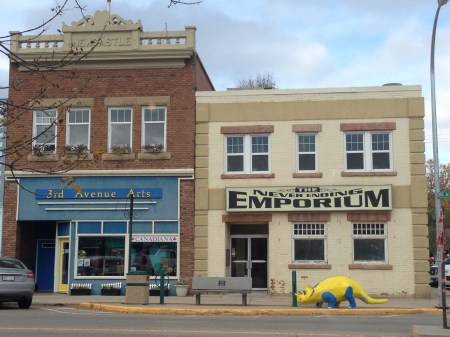
Drumheller embraces its dinosaurs (see #10)
2. Talented workers will move to loved communities: Place matters more than ever to the success of community economic development, according to Dr. Katherine Loflin, who spoke about “place-making” and the drivers behind it. Her research demonstrates that it’s not good enough any more that residents are satisfied living in a community. In order to attract younger, highly skilled talent, communities need to nurture a “commitment to place”, a multidisciplinary attachment. Your community must become the place no one ever wants to leave. Key drivers to place-making include social offerings (so people feel emotionally invested in a community), openness (welcoming to all vs. tolerant to specific groups), and aesthetics (how well a community can show off itself). Dr Loflin explained that the civility of a community’s citizens is critical to attracting new people. She also said that municipal budget cuts tend to affect place-making efforts first, which can leave a negative impression to newcomers.
3. Trade across the border is getting easier: Canada and the U.S. are making good progress on the joint Border Infrastructure Investment Plan (BIIP), according to William Sproull, Chair of the Governance Committee of the International Economic Development Council (IEDC). Given that Canada exports more goods to Michigan than to the European Union, it is about time. Trusted Traveler and Trusted Trader Programs are moving forward, as well as other Beyond the Border deliverables.

A fly-drive vacation promoted to U.K. visitors (Source: Frontier Canada)
4. Connect your community to the nearest airport: The Vice President of the Calgary Airport Authority, Stephan Pourier, inspired me to consider how to best to connect our community to airports. He explained that YYC is the third largest airport in Canada, thanks to an 80-year lease with government and $2.5 billion in private investment. Development of cargo and freight forwarding services has also encouraged the construction of 3 million square feet of industrial space on the airport lands.
5. Performance measures are more important than ever: Justin Riemer, Assistant Deputy Minister of Alberta Innovation and Advanced Education reminded us that when it comes to economic development, “outcome attribution is assumed, not proven.” He promoted the concept that policy can have a bigger impact than marketing, that sunset clauses should be placed on government programs to avoid creating dependencies. He reminded us that communities should limit the number of metrics used to measure economic development, and performance measures should reflect the goals and vision of the organization.

Calgary Mayor Nenshi wants senior governments to give back some of what they take from municipalities (Photo: design.ca)
6. Fiscal imbalance among governments needs to be fixed: Calgary Mayor Naheed Nenshi reminded the audience that Calgary sends $4 billion more in tax revenue to the Province of Alberta than it receives in services. He berated senior levels of government for not fixing the fiscal imbalance that exists for all cities and towns. The flood in Calgary proved to Mayor Nenshi that local government is the most important and relevant level of government to everyday citizens. He applauded the 20,000 workers at the City for their hard work, professionalism and dedication, adding “our job is made easier by the quality of the people we serve.”
7. Be likeable and trustworthy: Wealthy Barber Dave Chilton, who also appears on CBC’s Dragon’s Den, told stories about small business people and entrepreneurs who have become successful. “People like to deal with people they like and trust,” he explained, adding he believes in “the importance in life of being nice” to others. Chilton complained that increasingly people opt to be voluntarily in a bad mood. He said people have lost the ability to discriminate between a minor inconvenience and a major problem. Canadians have never been healthier and wealthier, and our nation is the best place to live. He reminded us that although we complain about our health care system, we are living longer than ever before, even if don’t exercise or eat properly. “If you are healthy and you are Canadian, it doesn’t get any better.”
8. Connect your college to your community: A panel, including the Association of Universities and Colleges of Canada, discussed the return on investment in post-secondary communities. One panelist encouraged us to talk about “citizens” not “taxpayers”. “If we don’t see the importance of growing citizens, no one else will.” Citizens look at themselves as sharing with others and giving back to their community. Taxpayers are simply consumers of public services and expect the lowest possible cost. The positive example was also raised, about a business group in St. Catharines that invites international students to breakfast to introduce them to local business leaders.
9. Be careful with P3s: A panel about private-public partnerships reminded us that P3s are not the magic bullet for community infrastructure. Martin Gordon, Senior Vice President of Opus International, urged communities to ensure that they clearly define the level of service of a facility which will be privately built and operated. “Incentivize the project so that the private sector is a long-term good asset steward,” he explained. Threshold participation in P3s is about $25 million for a building and $100 million for a large portfolio project. Smaller communities were warned to be prepared to put forward the time, resources and expertise into a project upfront, to avoid catastrophe later. Even if a community project does not develop into a P3, at least the exercise of scoping out a P3 can help a municipality understand the sustainable service level for a project, and to help reduce the infrastructure gap.
10. Dinosaurs don’t get old: Drumheller relies on dinosaur fossils for its tourism industry, which represents 27% of employment in the town, according to its tourism master plan. Natural gas is also a key employer. The Royal Tyrrell Museum (Canada’s only museum dedicated exclusively to the science of palaeontology) contributed $36.2 million to Alberta’s GPI (Genuine Progress Indicator), sustained 719 person-years of employment and generated nearly $14 million in tax revenues. Downtown, kids climb over fiberglas statues of dinosaurs and restaurants serve Dinosaur Pizza (hint: heavy in protein). At the tourist info centre, you can even climb up a huge dinosaur and look around the town. Kudos to a community that has embraced an authentic theme, turning it into an economic success.

Bike locker in Canmore, Alberta
11. We can always do more to welcome cyclists: Just when we thought installing a few bicycle racks in our towns was a major step forward to welcoming cyclists, other communities are already way out in front. Canmore, a small community between Calgary and Banff, is a leading light in cycling infrastructure. Expensive pedal bikes can be secured in low-profile lockers in the public parking lot, beside the washrooms. Nearby, a free, public bike maintenance stand offers wrenches and compressed air for cyclists. Local trail infrastructure is also world-class, and the scenery is gorgeous.
12. When you network with your peers, everyone learns: Whether you represent a mountain town reliant on ski tourism or a rural agricultural county, there is something to be learned from getting together.
The EDAC Conference was an educational, productive exercise that will help many communities do better in the future.
We all have seen it happen. A developer brings a proposal to a community. It is leading edge and promising. Local council loves the concept – so the proponent believes the community is a willing host. The developer beavers away on due diligence and approvals for a year or two, then returns to council for a zoning amendment. Council refuses it, due to negative community comments typically received hours before the meeting. The developer, their agent and the various government offices that recommended approval, are all in shock. Why did this happen?
The question isn’t a matter of Why, but How? Your elected officials were probably the victims of an availability cascade, a term explaining how misinformation can affect decision-making. It doesn’t matter that the misinformation is right or wrong, true or false. It is just misinformation that recirculates in the community in cascades of conversation, and for no other reason than its availability, it becomes a common belief.
The concept of availability cascades should be kept in mind as we hold another municipal election. Is the candidate susceptible to suggestion and whisper campaigns? Does this person quickly make up their mind on complex issues, or do they support deferring decisions until more information is available to them? Do they explore opinions or do they parrot their circle of influence?
The idea of the availability cascade was first developed by professors Cass Sunstein of Harvard and Timur Kuran of Duke University in a 1999 paper published in the Stanford Law Review, available on the Social Science Research Network. They describe an availability cascade as “a self-reinforcing process of collective belief formation by which an expressed perception triggers a chain reaction that gives the perception of increasing plausibility through its rising availability in public discourse”.
Sounds like a lot of gobbledygook, but it’s based on William James’ “dual process theory” – the way we reason. One way we think is based on the fast, automatic, unconscious thought patterns of our caveman ancestors, dominated by fear and aversion to risk. The other thought process is the slow, analytical, rational method of reasoning that developed as civilization evolved.
As an analogy, our brain’s decision-making process is like a man riding an elephant. The man is the slow thinker and the elephant thinks automatically and quickly. The man may be smarter but he has no control when the elephant sees a mouse.

Photo by Chiang Mai Elephant Tours
(If your brain concluded that elephants are afraid of mice, then you are a victim of an availability cascade. Apparently, there isn’t much evidence to prove that musophobia is general among pachyderms.)
The availability cascade is said to have influenced many headline-grabbing stories over the years: vaccination scares (MMR), environmental stories (Love Canal) and overblown food safety concerns (Alar Scare). A website called Retro Report purports to expose “the truth now about the big stories then”.
Even people who are educated and well read can be more susceptible to availability cascades. In his book, Thinking Fast and Slow, Daniel Kahneman explains how the emotional power of examples and their perceived frequency causes a mental shortcut to conclusions within people’s brains. It explains why people think celebrities have high divorce rates, because the media rarely reports on movie stars that stay married. It can also explain why politicians can rush to kill a project or a policy if they get two or three negative phone calls about it.
As the municipal election nears, consider which candidates can be easily influenced by people behind availability cascades. Sunstein and Kuran describe availability entrepreneurs as organizations and individuals who “attempt to trigger availability cascades likely to advance their own agendas.” Availability entrepreneurs are everywhere: gossiping in coffee shops, gabbing on social media, emailing your Councillor.
Do you plan to vote in the next election? Consider thinking fast and slow before marking an X on your ballot. The future of prudent decision-making in your community depends on it.

I’m very happy to be posting another Sam and Angela. In this comic I have put in my favourite musician, TV show character, video game character, and movie character. I hope you like it!
– CA$H

I haven’t been drawing Sam and Angela in a while, but I am finally making up more ideas and thinking about drawing Sam and Angela #9. Enjoy my latest Sam and Angela comic!
– CA$H
It’s been a while, so I’m back with another release of Sam and Angela! I’m sorry for the huge wait but I had a lot to catch up with. And the reason is a new series I’m in the making of, and a short story project I’m beginning to write to publish for a Teen’s Write contest.
Anyways, I hope you enjoy the 7th installment of Sam and Angela!
– CA$H

 Clark Hoskin
You must be logged in to post a comment.